
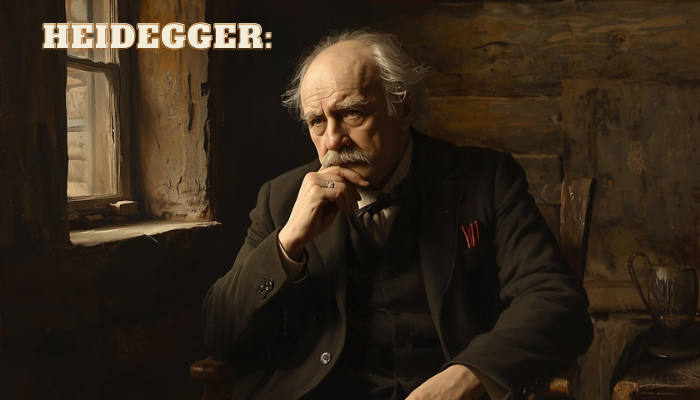
Martin Heidegger is one of those thinkers who changes the way you look at the world, whether you want him to or not. His ideas have a habit of slipping out of the philosophy classroom and into everyday life, quietly reshaping the way you think about Time, identity, technology, and what it actually means to exist. That is no small thing for a philosopher whose central question sounds, at first glance, almost childishly simple: What is Being?
But spend a little time with Heidegger, and you quickly realize there is nothing simple about it. This is a question that Western philosophy had been dancing around for over two thousand years, and Heidegger believed the entire tradition had been asking it in the wrong way. His mission, laid out most fully in his landmark 1927 work Being and Time, was to strip philosophy back to its roots and force the question of existence into the open.
This article is your accessible, honest introduction to Heidegger’s thought: who he was, what he was trying to say, why it matters, and why his ideas still generate debate and fascination nearly a century later.

Who Was Martin Heidegger?
Martin Heidegger was born in 1889 in the small town of Messkirch in Baden, Germany. He grew up in a modest Catholic household, and the Church shaped his early education. He studied theology before shifting his focus to philosophy, eventually coming under the influence of Edmund Husserl, the founder of phenomenology.
Husserl’s phenomenology was concerned with the structure of conscious experience, with how things appear to us as thinking subjects. Heidegger took this method and pushed it in a radically different direction. Rather than focusing on consciousness and knowledge in the manner of Descartes or Kant, he wanted to investigate the more fundamental question of Being itself.
He became a professor at the University of Marburg and later at Freiburg, where he had also studied under Husserl. His lectures were legendary, drawing students from across Europe who felt, often without being able to say exactly why, that something genuinely new was being taught in that lecture hall.
His life took a deeply troubling turn in 1933 when he joined the Nazi Party and briefly served as rector of Freiburg University. This period of his life has never stopped haunting the reception of his philosophy. The relationship between his thought and his politics remains one of the most contested and uncomfortable discussions in all of intellectual history. Scholars continue to argue about whether his political choices contaminate his philosophy, or whether the ideas can be separated from the man who held them.
Heidegger resigned the rectorship in 1934, but his association with National Socialism left a shadow that followed him for the rest of his life. He died in 1976, having continued to write, teach, and revise his thinking across several more decades.
The Central Question: What Is Being?
To understand Heidegger, you have to take the question of Being seriously. Most of us move through life without ever pausing to ask what it means for something to be. Chairs exist. People exist. Numbers, perhaps, exist. But what is existence itself? What does it mean to say that something is?
Heidegger argued that Western philosophy, since Plato and Aristotle, had systematically forgotten this question. Philosophers had become so absorbed in asking what kinds of things exist, and what we can know about them, that they stopped asking about the nature of Being as such. He called this the “forgetfulness of Being,” and he saw it as a catastrophic oversight that had shaped not just philosophy but the whole trajectory of Western civilization.
Heidegger’s goal was to reawaken this question, to pull it out of obscurity and make it unavoidable. This is what gives his work its strange, urgent quality. He is not simply adding to an existing philosophical conversation. He is insisting that the conversation has been going wrong from the very beginning.
Dasein: Being-There
One of the most distinctive features of Heidegger’s approach is his decision to investigate Being through a particular kind of being: the human being. He gave the human being a special name, Dasein, which translates roughly from German as “being-there” or “existence.”
The choice of this term is deliberate and revealing. Heidegger did not want to talk about “the subject,” “the mind,” or “the self” in the way previous philosophers had. All of those terms carried baggage he wanted to avoid. “Dasein” emphasizes something crucial: that human existence is always already situated, always located somewhere, always thrown into a world that it did not choose.
This idea of “thrownness” is one of Heidegger’s most evocative concepts. We find ourselves already here, born into a particular language, culture, historical moment, and body. We did not choose any of this. We are, as Heidegger puts it, thrown into existence. And yet, from within this situation we did not choose, we have to choose. We have to take up our existence and do something with it.
This tension between thrownness and the ongoing project of existing is at the heart of Heidegger’s account of human life.
Being-in-the-World
Another cornerstone of Heidegger’s philosophy is his rejection of the idea that the human mind is an isolated container that peers out at an external world. This picture, inherited from Descartes, treats the self and the world as two separate things that must be connected through knowledge.
Heidegger found this picture deeply mistaken. For him, Dasein is always already in the world, not as a brain in a body surrounded by objects, but in a much richer and more fundamental sense. We are practically engaged with our surroundings from the very start. We use things, we navigate spaces, we relate to others. The world is not first a collection of neutral objects that we then assign meaning to. The world shows up to us already meaningful, already organized around our concerns, habits, and practices.
His famous example is the hammer. When a carpenter is hammering, she is not primarily aware of the hammer as a physical object with a certain weight and shape. The hammer is “ready-to-hand,” transparent, part of the flow of purposive activity. It only becomes an object of attention, something “present-at-hand,” when it breaks or goes missing. The breakdown reveals what was always the background structure of engaged, practical existence.
This insight has been enormously influential in fields far beyond academic philosophy, including cognitive science, human-computer interaction design, and organizational theory.
Time, Finitude, and Authentic Existence
For Heidegger, Time is not simply a container in which events occur. Time is the very structure of Dasein’s existence. We are always oriented toward the future, drawing on the past, living through the present. And crucially, the future that defines us most deeply is the one we tend to avoid thinking about: death.
Heidegger calls death “the ownmost possibility” of Dasein. It is the one thing no one can take from you or do for you. It is yours alone, completely non-transferable. And the awareness of death, if we let it sink in rather than flee from it, can transform how we live.
Most of the Time, Heidegger argues, we live inauthentically. We lose ourselves in “the They” (das Man), the anonymous social world of convention, gossip, and comfortable conformity. We do what one does. We think what one thinks. We avoid the anxiety that genuine self-awareness would bring. This is not exactly a moral failing. It is the default mode of human existence, a kind of necessary social lubrication. But it comes at a cost.
Authentic existence, for Heidegger, involves owning your finitude, facing the anxiety that comes with recognizing your mortality, and taking hold of your life as genuinely yours. It does not mean withdrawing from society or becoming a heroic individualist. It means living with a clarity and ownership that inauthenticity tends to obscure.
This account of authenticity has obvious resonances with existentialist thinkers like Jean-Paul Sartre and Albert Camus, though Heidegger himself was uncomfortable with the existentialist label.
Heidegger and Technology
In his later work, Heidegger turned his attention to the question of technology, and the results were some of his most penetrating and controversial writings. His 1954 essay “The Question Concerning Technology” is now recognized as a foundational text in the philosophy of technology.
Heidegger’s argument is subtle and easy to misread. He is not simply saying that technology is dangerous or that we use it too much. His claim is more fundamental. Modern technology, he argues, represents a particular way of disclosing the world, a particular relationship to Being. He calls this the “enframing” (Gestell): the tendency to encounter everything as a “standing reserve,” a resource available for human use and optimization.
Under the dominance of enframing, a river becomes a potential source of hydroelectric power. A forest becomes timber. A human being becomes human capital. The world loses its depth, its mystery, its capacity to disclose something beyond our instrumental projects.
This does not mean we should abandon technology. Heidegger is not a Luddite. But he does think that our unreflective immersion in a technological way of relating to the world carries genuine risks, risks not of particular harmful technologies but of a narrowing of our capacity to experience and think at all.
These ideas have become increasingly relevant in an era of artificial intelligence, algorithmic optimization, and data-driven everything. Heidegger did not live to see the internet or the smartphone, but he gave us tools for thinking about them.
Language and the House of Being
One of Heidegger’s most quoted phrases comes from his later work: “Language is the house of Being.” By this, he means that language is not simply a tool we use to communicate thoughts we have independently formed. Language is the medium in which Being discloses itself to us. The way we speak shapes what we can encounter, what we can think, and what can show up as meaningful.
This sparked Heidegger’s deep interest in poetry, particularly the poetry of Friedrich Hölderlin, whom he read as a thinker in his own right, someone whose verse opened up possibilities of experience that philosophical prose could not. For Heidegger, genuine thinking and genuine poetry share a family resemblance: both involve a kind of listening to language, rather than merely using it.
This emphasis on language influenced a whole generation of subsequent thinkers, including Hans-Georg Gadamer, Jacques Derrida, and Paul Ricoeur.
Why Heidegger Still Matters
You might reasonably wonder whether a difficult German philosopher writing nearly a century ago has anything useful to offer someone living in the present. The answer, I think, is genuinely yes, but only if you are willing to do the work of engaging seriously with his ideas.
Heidegger gives us a vocabulary for thinking about what genuinely matters: the way practical engagement with the world differs from detached observation; the relationship between human existence and mortality; the risks of reducing everything to a resource; and the role of language and culture in shaping what we can experience.
These are not abstract puzzles. They are live questions for anyone trying to understand what it means to live well, to think clearly, and to take one’s own existence seriously.
At the same Time, the troubling facts of Heidegger’s biography should not be swept aside. Reading Heidegger thoughtfully means holding both things at once: the genuine power of his ideas and the genuine horror of his political commitments. Philosophy has rarely offered us a cleaner example of the difference between intellectual brilliance and moral character.
Getting Started with Heidegger
If you want to read Heidegger yourself, the most honest advice is: start slow, and do not expect clarity to come quickly. Being and Time is one of the most demanding texts in the Western philosophical tradition. A good secondary source, such as Hubert Dreyfus’s commentary Being-in-the-World, can make the primary text far more navigable.
His later essays, collected in volumes like Poetry, Language, Thought, and Basic Writings, are often more accessible and offer a different entry point into his concerns.