
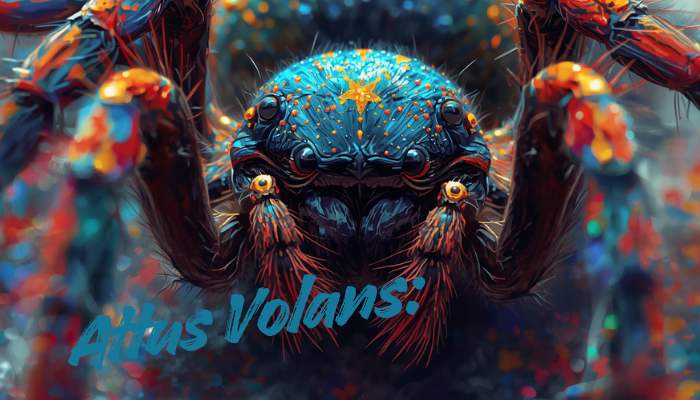
Have you ever imagined a spider that performs like a tiny performer on nature’s stage? Meet Attus volans, the original scientific name for one of the most captivating creatures in the arachnid world. Today better known as Maratus volans, this peacock spider has captured hearts through viral videos and scientific wonder. Its elaborate displays and jewel-like colors make it feel like a living piece of art rather than an eight-legged hunter.
I remember the first time I saw footage of one in action. It was impossible not to smile. This tiny spider, barely five millimeters long, raises a colorful fan on its abdomen and dances with such energy and precision that it rivals the most dedicated performers. Far from the scary image many hold of spiders, Attus volans invites curiosity and admiration. In this article, we will journey through its history, biology, behavior, and the reasons it continues to fascinate scientists and nature lovers alike.
A Name That Tells a Story
The story of Attus volans begins in 1874 when British arachnologist Octavius Pickard-Cambridge described the species from specimens sent from New South Wales, Australia. He named it Salticus volans initially, later placed under Attus. The Latin word “volans” means flying, inspired by reports that the spider used its abdominal flaps like wings or gliders during leaps.
Later taxonomic revisions moved it through Saitis volans before settling in the genus Maratus, established for these Australian peacock spiders. Marek Zabka’s work in 1991 helped solidify its current classification. Despite the name changes, the charm remains. Many still refer to it affectionately by its older names in historical contexts.
This reclassification reflects broader changes in how we understand spider relationships. Australian species often proved distinct from their European look-alikes, leading to new genera and deeper appreciation for the continent’s unique biodiversity.
Physical Characteristics: Small but Spectacular
Attus volans reaches only about four to five millimeters in body length. Females and juveniles appear relatively plain in brown tones with subtle patterns that help them blend into leaf litter and twigs. This camouflage serves them well as they go about their daily lives.
Males, however, are the showstoppers. Their cephalothorax and legs often show dark brown to black with red accents. The abdomen features striking iridescent patterns of red, blue, and green. Most notably, males possess expandable, flap-like extensions on the sides of the abdomen. When not in use, these flaps fold neatly against the body like a closed fan or shawl.
These flaps contain specialized scales that create the vivid colors through structural coloration and light reflection. Some scales even allow shifts in hue depending on the angle of light, producing mesmerizing effects in both visible and ultraviolet spectra. The third pair of legs features brushes of black hairs with white tips, which play a key role in displays.
Both sexes have the large, forward-facing eyes typical of jumping spiders in the family Salticidae. These eyes provide exceptional vision, among the best in the invertebrate world for their size.
Extraordinary Vision: Seeing the World in Detail
Jumping spiders like Attus volans possess eight eyes arranged in a way that maximizes their hunting and social abilities. The two large principal eyes act like high-resolution telephoto lenses with a tiered retina, allowing them to see fine details and even detect ultraviolet light. The secondary eyes help detect motion across a wide field.
This visual prowess evolved primarily for hunting but proved perfect for complex courtship. Males can spot females from a distance and gauge their reactions during dances. Females use their sharp eyesight to evaluate the quality of a suitor’s performance. Researchers believe this keen vision also supports navigation through varied habitats and precise jumps up to 40 times their body length.
Habitat and Distribution Across Australia
These spiders call Australia home, with records from Queensland, New South Wales, the Australian Capital Territory, Western Australia, and Tasmania. Unlike some Maratus species restricted to narrow niches, Attus volans shows adaptability across many environments. You might find them in grasslands, sand dunes, eucalyptus forests, or among dry leaf litter and twigs.
They are primarily ground-dwellers but climb vegetation for better vantage points during courtship or hunting. Females may mimic leaf scars or blend into bark for protection while guarding eggs. Their wide distribution highlights resilience and versatility in Australia’s diverse ecosystems, from temperate to semiarid regions.
Activity peaks during the Austral spring, from August to December, aligning with warmer weather and increased prey availability. This timing supports successful reproduction before harsher summer conditions.
Masters of the Hunt: Lifestyle as Cursorial Predators
Attus volans does not spin webs to catch prey. Instead, these diurnal hunters rely on stealth, speed, and their incredible eyesight. They stalk small insects and other spiders, approaching carefully before launching an accurate jump to deliver a venomous bite.
As cursorial hunters, they roam actively rather than waiting in ambush. This lifestyle likely drove the evolution of their advanced visual system. Their venom works quickly on small prey, allowing efficient feeding without the need for silk traps. In the ecosystem, they help control populations of insects, playing a valuable role in local food webs.
The Famous Courtship Dance: Nature’s Tiny Spectacle
Nothing defines Attus volans quite like the male’s courtship display. When a male detects a potential mate, often through pheromones on silk draglines or visual cues, he begins an elaborate performance that can last from a few minutes to nearly an hour.
He starts by raising his third pair of legs and waving them to catch attention. Vibrations produced by abdominal movements, called rumble-rumps, travel through the substrate to alert the female. Once she faces him, he raises his abdomen, unfurls the colorful flaps into a circular fan fringed with white hairs, and begins dancing side to side.
The display includes leg waves, body vibrations, pedipalp flickers, and precise movements. He may clap his legs or perform a rolling motion while advancing slowly. The third legs, with their black brushes and white tips, add dramatic flair. Colors shimmer in the light, creating a living kaleidoscope designed to impress.
Scientists have identified multiple vibration types: rumble-rumps for initial attraction, and crunch rolls or grind-revs closer to mounting. Males that invest more energy in both visual and vibratory elements tend to have higher success rates. Persistence, proximity, and maintaining eye contact also matter.
Females signal interest by stretching out their own third legs. If unimpressed, they may attack. This risk drives the evolution of such extravagant displays. Successful copulation can last minutes to hours, after which the male may seek other mates while the female guards her future offspring.
Sexual Selection and Evolutionary Insights
The peacock spider exemplifies runaway sexual selection. Females choose mates based on display quality, which may indicate overall fitness. Brighter colors, more vigorous dancing, and stronger vibrations signal good health and genes worth passing on.
The abdominal fan and leg ornaments represent significant investment. Producing and maintaining these features costs energy, and displaying makes males more visible to predators. Yet the reproductive payoff justifies the risks. Studies show females often mate only once, making each courtship attempt high-stakes for males.
This multi-modal signaling, combining vision, vibration, and possibly pheromones, offers rich material for evolutionary biologists. Research by Madeline Girard and others has deepened understanding of how complex communication evolves in small animals.
Interestingly, females may become more aggressive after mating or if already unreceptive, using signals to discourage further advances and conserve energy while avoiding unnecessary risks.
Life Cycle: From Egg to Elegant Dancer
Females lay six to 15 eggs in silken nests, often underground or in protected spots during December. They guard these clutches devotedly. Males mature earlier, appearing from August, while females follow and live longer. The total lifespan hovers around one year.
Immature males lack the full fan and leg specializations until maturity, when colors develop. Juveniles resemble drab females, relying on camouflage rather than display. This sexual dimorphism becomes pronounced only in adulthood.
Debunking Myths: They Do Not Actually Fly
Despite the name “volans” and “flying spider,” these creatures do not fly or glide using their flaps. The abdominal extensions serve purely for courtship. They jump impressively but the flaps stay folded during normal movement. Julianne Waldock and others have helped clarify this urban myth.
Conservation and Cultural Appeal
While not currently listed as threatened, habitat preservation remains important for all Maratus species. Urban development, climate change, and habitat fragmentation could affect local populations. Their popularity through photography and video has raised awareness about invertebrate conservation and the beauty of small creatures.
Jürgen Otto’s pioneering videos brought Attus volans to global audiences, sparking interest in peacock spiders and leading to the description of many new species. Citizen scientists and nature enthusiasts contribute significantly to our knowledge.
Why Attus Volans Captivates Us
There is something profoundly human about appreciating this spider’s efforts. Its dance reflects persistence, creativity, and the universal drive to connect. In a world that often overlooks tiny lives, Attus volans reminds us that wonder exists at every scale.
Whether you encounter one in the Australian bush or watch high-quality footage, take a moment to appreciate the engineering, evolution, and sheer personality packed into such a small package. These spiders do not just survive. They perform, communicate, and thrive with remarkable sophistication.
Next time you are outdoors in their range, keep an eye on the leaf litter. You might witness one of nature’s most delightful mini-dramas unfolding. The peacock spider teaches us that elegance, boldness, and determination come in all sizes. Its story continues to inspire researchers, artists, and anyone who values the intricate beauty of the natural world.