
A Small Slice with a Big Story
Some foods carry a whole world of history in a single bite. Melba toast is one of them. Thin, dry, impossibly crisp, and golden, this humble little cracker has graced the tables of grand hotels, hospital trays, fine dining restaurants, and everyday kitchens for well over a century. It is the kind of food that people often take for granted until they really stop to think about where it came from and just how much it can do.
At first glance, Melba toast looks almost too simple to discuss at length. It is, after all, bread that has been sliced thin and toasted twice. But simplicity in food is rarely the whole story. Behind Melba toast is a tale of culinary celebrity, medical necessity, creative genius, and the kind of elegant restraint that never truly goes out of style. It is a food that rewards curiosity, and anyone who takes the time to understand it properly will find it showing up in their kitchen far more often.
The Origin Story: A Toast Named for a Singer
The story of Melba toast begins in the late nineteenth century and involves two figures who were both legends in their own right. The first is Dame Nellie Melba, the Australian operatic soprano who was one of the most celebrated performers of her era. Born Helen Porter Mitchell in 1861 near Melbourne, she took her stage name from her home city and went on to become an international sensation whose voice filled the grandest opera houses in Europe.
The second figure is Auguste Escoffier, the legendary French chef who essentially codified the foundations of classical French cuisine and ran the kitchens of the Savoy Hotel in London during the height of his influence. Escoffier was famous not only for his cooking but for his habit of naming dishes after notable guests and performers he admired.
The story goes that Nellie Melba fell seriously ill in 1897 and was placed on a strict diet that severely limited what she could eat. During her recovery, she could manage very little solid food, and the challenge was finding something gentle enough on her system while still providing some sustenance and variety. Escoffier, ever the thoughtful and inventive chef, devised an extremely thin, twice-toasted slice of bread that was light, easy to digest, and satisfyingly crisp. He named it in her honor.
There is some debate among food historians about the precise details of this origin story. Dates, circumstances, and locations have been disputed over the years, and more than one version of the tale exists. What is not disputed is that the association between Dame Nellie Melba and this style of crisp toast became firmly established in the public consciousness, and the name stuck. By the early twentieth century, melba toast was appearing on menus, in cookbooks, and in diet guides across Europe and North America.
Escoffier also created Peach Melba in her honor, a dessert of poached peaches and raspberry sauce served with vanilla ice cream, which remains one of the most famous named dishes in classical French cuisine. Between the toast and the peach dessert, few performers in history have been immortalized in food quite so deliciously.
What Makes Melba Toast Different from Regular Toast
The distinction between melba toast and ordinary toast is more significant than it might first appear, and it comes down to both technique and intention.
Regular toast is simply bread that has been exposed to direct heat long enough to brown and crisp its surfaces while leaving the interior soft. The result is warm, slightly crunchy on the outside, and chewy within. It is satisfying and familiar, but it is fundamentally still bread.
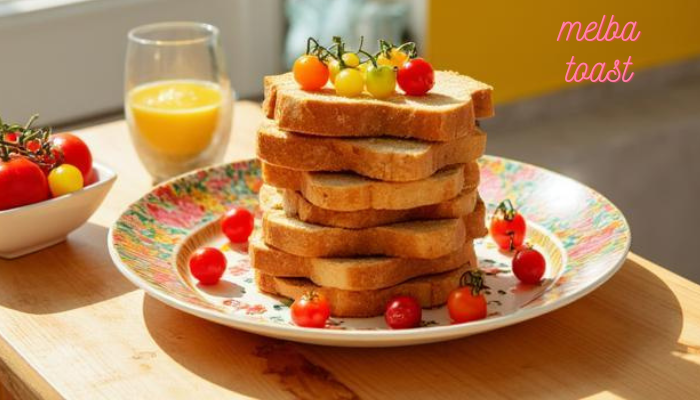
Melba toast goes several steps further. The process typically involves taking a slice of bread, toasting it lightly until just done, and then carefully splitting it horizontally through the middle to create two very thin halves. Each half is then returned to the heat, cut side up, and toasted again until it is completely dry, uniformly golden, and utterly crisp all the way through. There is no soft interior left at all. The finished product snaps cleanly when broken and has a delicate, almost papery texture that is entirely its own.
This double-toasting process drives out virtually all moisture from the bread, which is precisely what gives melba toast its characteristic qualities. The low moisture content means it stores well, maintains its crunch even in relatively humid conditions, and provides a very different mouthfeel from other bread products. It dissolves pleasantly as you eat it rather than requiring much chewing, which was part of its original appeal as a food suitable for convalescents.
The bread used matters considerably. Traditional melba toast is made from white sandwich bread, which produces a neutral, delicate result. Whole-wheat and rye versions offer richer flavors and additional fiber. Sourdough melba toast carries a pleasing tang. Each variation behaves slightly differently during toasting, and experimenting with different breads is one of the pleasures of making it at home.
The Nutritional Side of Things
Melba toast has long been associated with dieting and calorie-conscious eating, and for good reason. Because the bread is sliced extremely thin and contains no added fats or oils in its preparation, a few pieces of melba toast represent a fairly modest caloric contribution.
Commercially produced melba toast typically contains around 15 to 20 calories per piece, depending on size and type. This makes it an appealing option for people who want the satisfaction of something crisp and carbohydrate-rich without consuming a large number of calories. For many years, Melba toast was a staple of various diet programs and weight management plans for exactly this reason.
The nutritional profile beyond calories is relatively modest. Melba toast made from white bread provides some carbohydrates and a small amount of protein, but not much fiber or micronutrients. Whole-grain versions improve this picture considerably, offering more dietary fiber, B vitamins, and minerals. For anyone who eats Melba toast regularly and hopes to get more nutritional value from it, choosing whole-wheat, rye, or multigrain varieties is a straightforward upgrade.
It is worth noting that the original medical context in which Melba toast was developed focused more on digestibility than on caloric restriction. The dryness and lightness of the toast made it easy on a sensitive or recovering digestive system. This quality still holds today. Many people find Melba toast easier to tolerate than regular bread when dealing with nausea, stomach upset, or digestive discomfort.
Melba Toast in the Kitchen: Versatility Worth Celebrating
One of the most compelling arguments for keeping melba toast in your culinary repertoire is its genuine versatility. This is not a food that sits in one corner of the menu. It moves across courses, occasions, and flavor profiles with surprising ease.
As a base for canapés and appetizers, melba toast is essentially ideal. Its neutral flavor does not compete with toppings, its firm, flat surface provides a stable platform, and its size is perfectly suited to one or two bites. Classic combinations include smoked salmon with cream cheese and capers, chicken liver pâté with a small cornichon, or a sliver of Brie with a thin slice of pear. At a dinner party or gathering, a tray of Melba toast topped with elegant bites looks considerably more polished and intentional than a bowl of crackers, yet requires very little additional effort.
Alongside soups, melba toast is a quietly wonderful companion. Where crusty bread can overpower a delicate broth or cream soup, the lightness of melba toast complements without overwhelming. It adds texture to the eating experience without shifting the focus away from the soup itself. French onion soup, vichyssoise, tomato bisque, and elegant consommés all pair beautifully with a few pieces of melba toast on the side.
As a vehicle for dips, spreads, and cheese, Melba toast holds its own against far more elaborate crackers. Hummus, tzatziki, taramasalata, and baba ganoush all work well scooped onto its crisp surface. Soft cheeses like ricotta and goat cheese spread cleanly onto toast without crumbling it when handled with a light touch. Harder cheeses can be layered on top with accompaniments such as honey, fruit preserves, or a small leaf of fresh herb.
For breakfast and light meals, melba toast with a thin spread of good butter and a little honey or marmalade is a genuinely pleasant option. It provides something to chew without the heaviness of a full slice of bread, and its crunch feels satisfying in a way that softer foods sometimes do not.
How to Make Melba Toast at Home
Making melba toast at home is one of those kitchen tasks that sounds more complicated than it actually is, and the results are noticeably better than most commercial versions.
Start with good-quality white sandwich bread, preferably from a standard loaf with even, moderately thin slices. Artisan breads with irregular crumb structure can work, but are slightly more challenging to split evenly. Toast the bread lightly in a toaster or under a grill until it is just golden on both sides, still slightly soft in the middle, and firm enough to handle.
Remove the crusts if a more refined presentation is desired, though leaving them on is perfectly acceptable for an informal setting. Now comes the key step: using a sharp, serrated knife held parallel to the cutting board, carefully slice horizontally through the middle of each piece of toast, separating it into two thin halves. Work slowly and keep the knife level. The bread will be firmer than raw bread and easier to split cleanly than you might expect.
Place the split halves cut side up on a baking tray and return them to a low oven, around 150 to 160 degrees Celsius, or under a low grill. Watch them carefully. They will curl slightly at the edges as they dry out, which is normal and appealing. After about ten to fifteen minutes in the oven, depending on thickness, they should be completely golden, dry, and crisp all the way through. Remove them and allow them to cool on a rack. They will crisp further as they cool.
Homemade melba toast keeps well in an airtight container at room temperature for several days. If it softens slightly in humid conditions, a few minutes in a low oven will restore its crunch.
Variations worth exploring include brushing the cut surface lightly with olive oil and a sprinkle of sea salt before the second toasting, rubbing a cut clove of garlic over the surface for a subtle savory note, or dusting with a little sweet paprika or dried rosemary for seasoned versions that work particularly well with cheese.
Commercial Melba Toast and What to Look For
For those who prefer the convenience of ready-made melba toast, the commercial market offers a wide range of options. The most widely available varieties are the plain, round, or rectangular white toast versions found in most supermarkets. Still, the range extends to whole wheat, rye, sesame, onion, and various multigrain options.
When choosing commercial melba toast, pay attention to the ingredient list. The best versions contain little more than flour, water, yeast, and salt. Products with long lists of additives, preservatives, and flavor enhancers tend to be inferior in both taste and texture to simpler versions. Whole grain options with visible seeds and grains generally offer more flavor complexity and a more satisfying eating experience than refined white versions.
Some specialty food shops carry artisan melba toast made from sourdough or heritage grain flours, and these are worth seeking out if you enjoy the product regularly. The depth of flavor in a well-made sourdough melba toast is considerably greater than that of standard commercial versions.