
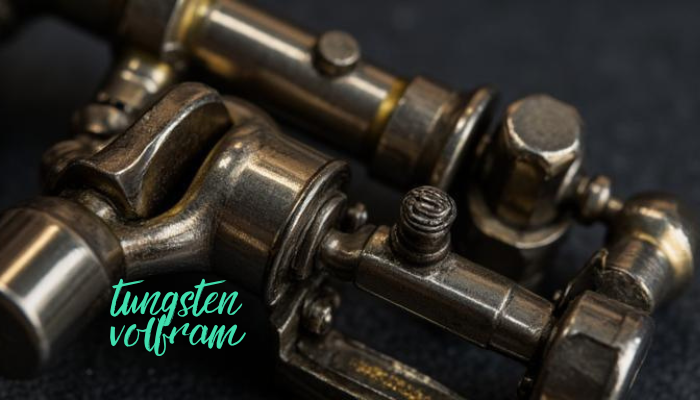
Tungsten (Wolfram): The Toughest Metal You’ve Never Heard Of
Most people have never held pure tungsten, yet they probably carry a tiny bit every day. Known as tungsten or wolfram, this heavy, silvery metal hides inside light bulbs, smartphone vibrators, wedding rings, and pen tips. Boasting the highest melting point of any metal, it withstands acids that dissolve steel, and stays solid at temperatures that melt aluminum. Tungsten is truly the quiet overachiever of the periodic table.
A Name with Two Identities
The metal has two names because two different groups discovered it at roughly the same time, and neither wanted to give up their claim.
In 1781, Swedish chemist Carl Wilhelm Scheele studied a heavy mineral called tungsten, Swedish for “heavy stone,” and realized it contained a new element. Two years later, Spanish brothers Juan José and Fausto d’Elhuyar isolated the metal and kept the name tungsten.
Meanwhile, in Germany and much of central Europe, miners had complained for centuries about a troublesome mineral that showed up alongside tin ore and “stole” the tin during smelting. They nicknamed it wolf rahm, or “wolf cream,” because it foamed like a wolf’s mouth and devoured valuable metal the way a wolf devours sheep. When chemists finally identified the culprit as the same element, the old miners’ curse stuck. The chemical symbol “W” on the periodic table is the last surviving tribute to that grumpy medieval nickname.
Properties That Defy Common Sense
Tungsten endures extremes that destroy ordinary metals.
- Melting point: 3,422 °C (6,192 °F). Only carbon (as graphite turning to diamond under pressure) beats it among the elements.
- Boiling point: around 5,930 °C. For comparison, the surface of the Sun is about 5,500 °C.
- Density: almost as heavy as gold (19.25 g/cm³ versus gold’s 19.32 g/cm³). A small cube feels shockingly weighty.
- Hardness: pure tungsten is brittle, but when alloyed with a little carbon, it becomes tungsten carbide, one of the hardest materials known to man. Wedding rings made of tungsten carbide can survive decades of daily wear without a single visible scratch.
Because of these gifts, engineers turn to tungsten whenever something has to survive ridiculous heat or abrasion.
From Mines to Your Pocket
About 80 % of the world’s tungsten comes from China, with smaller but important deposits in Russia, Canada, Bolivia, and Portugal. The ore looks nothing like shiny metal. Miners dig up rocks of scheelite (calcium tungstate) or wolframite (iron-manganese tungstate), roast them, dissolve them in acid, and finally reduce the powder with hydrogen to get pure tungsten metal. The process is long, expensive, and explains why the metal costs far more than steel.
Once refined, tungsten powder gets pressed and sintered (heated just below melting) into solid bars. From there, it heads off to very different careers.
Everyday Heroes Made of Tungsten
Smartphone vibration motors
That satisfying buzz when you get a text? A tiny tungsten weight spins off-center on a motor shaft. Its density packs maximum punch into minimum space.
- Light-bulb filaments (the old kind)
Thomas Edison tested thousands of materials before settling on tungsten in 1904. A modern halogen bulb still uses a coiled tungsten wire that glows white-hot without melting. - Wedding and fashion rings
Tungsten carbide rings became widely popular around 2010. They remain polished, do not bend, and can only be removed in an emergency by cracking them with vice-grip pliers. - Pen balls
The rolling ball in your ballpoint pen is almost always tungsten carbide. It has to survive millions of revolutions while resisting ink corrosion. - X-ray tubes and radiation shielding
Hospitals use tungsten’s density to block harmful radiation while letting the useful beam through a small window. - Rocket nozzles and jet-engine turbine blades
SpaceX, Blue Origin, and military engines rely on tungsten alloys where exhaust temperatures exceed 3,000 °C.
The Dark Side: Conflict Metal Concerns
Like cobalt and tantalum, tungsten has appeared on “conflict mineral” watch lists. Rebel groups in the Democratic Republic of Congo have mined wolframite to fund violence. Because of this, many countries now require companies to prove their tungsten supply chain is clean. Responsible jewelers and phone manufacturers proudly advertise “conflict-free tungsten” the same way they do conflict-free diamonds.
Fun Facts to Drop at Your Next Dinner Party
- A single teaspoon of tungsten weighs as much as a golf ball.
- If you made a cube of tungsten 37 cm (about 14.5 inches) on each side, it would weigh one metric ton.
- During World War II, Portugal stayed officially neutral but quietly became very rich selling wolframite to both Allied and Axis powers.
- The element’s atomic number is 74, and its name in French, German, Turkish, and dozens of other languages is still wolfram.
Looking Ahead
Demand keeps climbing. Electric vehicles need tungsten in drill bits to mine lithium and cobalt. Wind turbines use it in gearboxes. Reusable rockets push the limits of heat resistance, and tungsten is one of the few metals that can keep up.
Recycling is improving, too. Old drill bits, carbide tooling, and even spent light-bulb filaments now get ground up and reborn instead of dumped in landfills.
The next time you feel your phone vibrate, write with a pen, or notice a scratch-free wedding band, consider the remarkable metal behind these everyday items. Tungsten, or wolfram, has quietly served for centuries—tougher than steel, withstanding heat that melts most metals, and content to let other elements attract attention.